
Most master bedroom ideas assume you are starting from an empty room. You are almost certainly not. The useful question is which single change moves the room furthest, and in a bedroom that is rarely the thing you were about to buy.
Styling a main bedroom is less a formula than a set of choices about where the eye lands and what it is allowed to ignore. Below are fifteen ideas that work in a real room with existing furniture, grouped so you can stop at any point. Nothing here needs a full redesign, and about half of it needs no spending at all.
How to approach master bedroom design without a full redesign
A bedroom fails in one of three ways: it has no focal point, it has too many, or it has one and something else keeps stealing it. Almost every problem people describe as “the room feels unfinished” is one of those three, and none of them is solved by adding another cushion.
Work in order. Decide the focal point, remove whatever competes with it, then fix the light, then add texture. Colour and accessories come last because they are the cheapest to change and the easiest to get wrong when the structure underneath is unresolved.
The one question to ask before you buy anything
Stand in the doorway and ask what your eye goes to first. If the answer is the bed, the room is working and you are decorating. If the answer is a wardrobe door, a radiator, a pile of clothes or a television, that is your project, and no amount of bedding will out-argue it.
15 master bedroom ideas for a calm, intentional space
1. Define the room’s focal point, and remove the rest
In almost every bedroom the focal point should be the bed. That means everything on the same wall serves it: art centred above the headboard, lamps matched in height, nothing tall or bright at the edges pulling the eye sideways. If two walls are competing, the fix is subtraction, not balance.
2. Use built-in joinery to reclaim floor space
Built-in joinery can be a brilliant way to make use of limited space in a bedroom, particularly around a chimney breast or in the dead corner beside a door. Fitted wardrobes that run flush to the ceiling remove the dust gap, the visual break and the boxes that live on top of a freestanding wardrobe. It is the single most expensive idea on this list and usually the one that changes the room most.
3. Layer one warm light source, not three lamps
Three cool lamps produce a lit room. One warm lamp, at around 2700K, produces an evening. If you only change one thing tonight, change the bulbs on either side of the bed and put the overhead light on a dimmer or stop using it after dark.
4. Mix interesting pieces to elevate beyond the ordinary
A mix of interesting pieces can help elevate a bedroom beyond the ordinary. In practice this means resisting the matched set. One older wooden piece among newer furniture, or one chair that does not belong to the suite, gives the room a history it would not otherwise have.
5. Choose calming wallpaper or paint for two-tone walls
Calming wallpaper and two-tone walls both do the same job: they give the room a horizon. A darker tone to about one third height, or a papered headboard wall against plain paint elsewhere, lowers a high ceiling and anchors the bed without any joinery. Our guide to a bedroom feature wall covers which wall to pick.
6. Bring the outside in with a single plant or natural material
One plant, chosen for the light the room actually gets, does more than three struggling ones. If the room is dark, use material instead of foliage: a rattan bench, a linen curtain, a stone lamp base. There is more on that thinking in our notes on natural bedroom decor.
7. Customise your nightstand for function, not just display
Decide what genuinely lives on the nightstand: a lamp, a glass, a book, a charging cable if you must. Then choose the piece around that list rather than the other way round. A drawer beats an open shelf, because an open shelf is a display you have to maintain every day.
8. Set the ambiance with wall-mounted or statement lighting
Wall-mounted reading lights free both nightstands and stop the lamp-versus-book argument entirely. If the ceiling allows it, a single pendant offset to one side is more interesting than a central fitting, and reads as deliberate rather than builder-standard.
9. Make storage decorative with slatted panels or textured doors
If you cannot hide storage, give it a surface worth looking at. Slatted timber, reeded glass or a painted door in the wall colour all turn a wardrobe from an object into part of the architecture. Matching the door to the wall is free if you are painting anyway.
10. Layer your bedding for texture, not bulk
Three layers is the limit that still looks intentional: a fitted base, a duvet, and one throw or quilt folded at the foot. Vary the texture rather than the colour, so linen against waffle against wool. Bulk without texture reads as a hotel; texture without bulk reads as a home.
11. Integrate end of bed seating only if you will use it
A bench at the foot of the bed is genuinely useful for dressing and for closing the sightline out of the door. It is also the most reliable place in a bedroom for clothes to accumulate. Be honest about which one it will be in your house.
12. Choose a colour mood and commit to it
Popular colour moods for main bedrooms include a contemporary scheme with terracotta accents, a classic country palette, and a modern neutral retreat. Pick one and stay inside it. Most bedrooms that feel restless are running two moods at once, usually because one arrived with the furniture and the other arrived with the paint.
13. Hang curtains high and wide
Mount the pole close to the ceiling and extend it past the reveal on both sides. The window looks taller, the glass stays uncovered when the curtains are open, and the room gains light it already had. This costs the price of a longer pole.
14. Treat the wall opposite the bed as the second view
It is the wall you look at every morning and almost nobody plans it. One considered piece of art, or a mirror that reflects the window rather than the bed, is enough. A television belongs here only if it is the wall, not an afterthought bolted over something else.
15. Leave one surface empty
Choose a chest, a windowsill or a shelf and keep nothing on it. An empty surface is what makes the rest of the room read as chosen rather than full, and it is the only idea on this list that gets easier the longer you do it.
Where to start if the room is small
In a smaller main bedroom the order changes slightly: storage first, then light, then colour. Floor space is the scarce resource, so joinery, a bed with drawers, and wall-mounted lighting buy more than any decorative decision will. We go further into that trade-off in our small bedroom ideas, and our neutral bedroom decor guide covers how to keep a pale scheme from going flat.
Common questions
What are the latest trends for master bedrooms?
The steady direction is toward warmer neutrals, fitted joinery instead of freestanding wardrobes, two-tone or panelled walls, and wall-mounted lighting that frees the nightstands. Terracotta and muted clay accents have replaced grey as the default warm tone, and bedding has moved toward texture rather than pattern.
What is considered the best layout for a master bedroom?
The bed centred on the longest solid wall, with a clear walking route on both sides and a view of the door from the pillow. Storage goes on the wall you do not see from the bed, and the wall opposite the bed carries one considered piece rather than several.
What are the golden rules for designing a bedroom?
One focal point, warm light at a low level after dark, no more than three textures in the bedding, storage that closes, and at least one surface kept empty. If a decision does not serve sleeping or dressing, it is decoration and should come last.
What colours are most effective in a master bedroom?
Low-contrast warm tones work best: oatmeal, clay, muted terracotta, soft greens and the deeper blues used as an accent rather than an envelope. Pure brilliant white turns cold in a north-facing room, and high-saturation colour on more than one surface tends to keep the room feeling awake.
Shop the Look
Soft layers that turn a bedroom into a sanctuary of calm and texture.
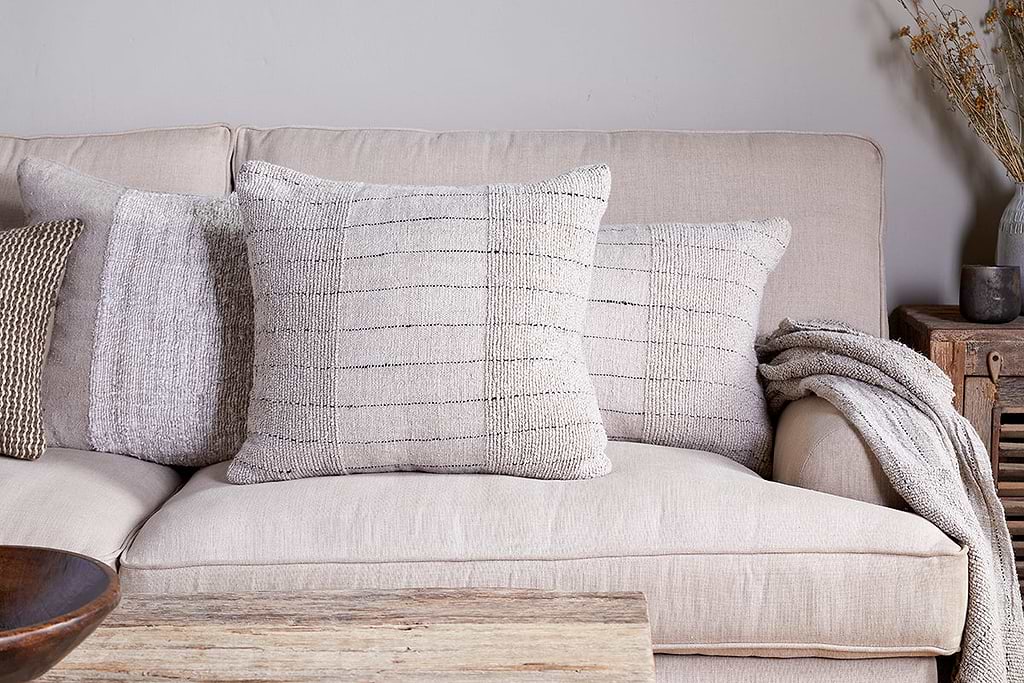
Mayla Cushion Cover
Soft hand-textured cover, instant warmth on linen sofas or chairs.
View at Nkuku →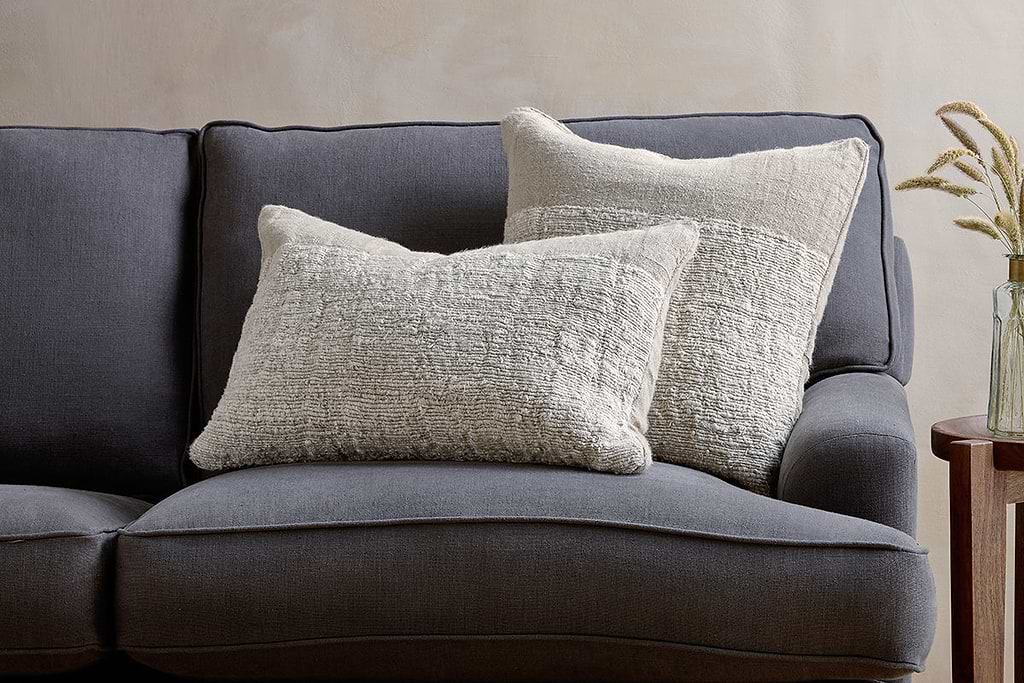
Puli Linen Cushion
Recycled linen in natural, pairs with woven textures and aged wood.
View at Nkuku →
Some links above are affiliate links. If you buy through them we may earn a small commission at no extra cost to you. We only suggest pieces we think fit a calm, lived-in home.
Free guide
The Calm Shelf
12 styling ideas to help you compose calm, balanced shelves in natural texture homes.